By: Louis Catania, Division of Infectious Disease and medically reviewed by Ann K. Avery, MD, Infectious Disease Physician at MetroHealth Medical Center
One of the most powerful things you can do for your mental health has nothing to do with a screen, an app, or even a therapy session. It's as simple as doing something with your hands.
Science backs this up. Hands-on physical activities, especially ones that produce something you can see, feel, and touch, activate the "effort-driven rewards circuit" in the brain. Translation? Making things with your hands genuinely lifts your mood, builds resilience, and helps protect against depression, not as a replacement for your care, but as a real, powerful addition to it.
And for people living with HIV, who are navigating stigma, medical stress, and sometimes isolation on top of everyday life, that matters a lot.
Your brain needs a break, too
Here's the thing about stress: it lives in your nervous system whether you acknowledge it or not. Scrolling TikTok in bed might feel like rest, but it's just redirecting your anxiety somewhere else. Your brain is still working and still processing.
When you shift into something hands-on and repetitive, stitching, planting, shaping clay, your brain actually gets to go offline for a little while. And that's when something almost magical happens. Clarity shows up uninvited. Your shoulders drop two inches without you even noticing.
If you've been feeling burnt out, overwhelmed, or just done with the noise, here are some analog hobbies worth trying. No experience required. No talent necessary. Just you, something to do with your hands, and a willingness to show up for yourself.
Mental health hobbies worth trying
Journaling or bullet journaling
If there's one place to start, it's here. Journaling is raw, unfiltered, and completely yours. You don't have to be a writer. You don't have to make it pretty. Just get it out of your head and onto paper, and that act alone can be genuinely transformative.
Bullet journaling takes it a step further, mixing written reflection with creativity. Watercolor pages, mood trackers, lists, doodles, whatever helps you process. For anyone navigating the emotional complexity of living with HIV, having a private space to be fully honest is powerful medicine.
Knitting or crocheting
Don't sleep on this one. Gen Z has already figured out what grandma knew all along: there is something deeply calming about the rhythm of yarn and needles. Knitting and crochet are repetitive enough to quiet the mind but engaging enough to keep you present. The result is often something you can wear and show off, made by hand, that hits differently than anything you could buy.
It's also deeply portable. Waiting room anxiety before a lab appointment? Bring your yarn. You'll be surprised at what happens.
Macrame
Macrame is having a full renaissance, and it is not slowing down. This fiber art (think knotted wall hangings, plant hangers, and woven home décor) is meditative in the best way. The knots are repetitive enough to get you into a flow state, but the patterns are interesting enough to keep your brain gently engaged. Modern macrame is nothing like your grandmother's version, either. It's bold, textural, and genuinely beautiful. YouTube has more beginner tutorials than you could ever need, and the supplies are affordable.
Puzzles
Deeply underrated. There is something about the slow, methodical work of a puzzle that forces you into the present moment in a way that feels almost like cheating. No past. No future. Just the piece in your hand and the question of where it fits. Puzzles are also thrift store gold. Your favorite thrift stores will almost always have a stack of them for a dollar or two. Just shake the box and listen for pieces before you buy. Missing pieces are a whole different kind of stress we don't need.
Legos
Yes, Legos. For adults. Fully and unapologetically. Lego sets designed for adults are no joke; intricate, challenging, and wildly satisfying to complete. And if budget is a concern, thrift stores, resales on social media, and online auction sites are genuinely excellent sources for bulk Lego finds. Building something piece by piece, watching it take shape in your hands, that's the effort-driven reward circuit doing exactly what it was designed to do. And it's also a great option for anyone who finds structured, systematic tasks grounding.
Gardening
Getting your hands in actual dirt has been shown to reduce cortisol (the stress hormone) and improve mood. There's something about tending to something living, watching it grow in response to your care. Your little garden quietly mirrors the work you're doing on yourself.
You don't need a yard. A few pots on a balcony or windowsill will do. Hydroponic grow stations are an easy hack for growing lettuce or herbs. Start small. Grow something. Let it remind you that growth takes time, and that's okay.
Upcycling
This one is as practical as it is creative. Upcycling means taking something old—a worn-out jacket, a glass jar, a pile of fabric scraps—and transforming it into something new and useful. It's resourcefulness as an art form. There's real satisfaction in looking at something most people would throw away and seeing its potential instead. That idea speaks directly to anyone who has developed strength and resilience through tough times.
Jewelry making
Designing your own bracelets, necklaces, or earrings is more accessible than it sounds. You can start incredibly simply, jump rings and beads, a few basic tools, and build your skills from there into wire wrapping or clay work. The entry cost is low, the learning curve is gentle, and the payoff of wearing something you made yourself? Unmatched. It's also a hobby that naturally lends itself to community. Swap supplies, trade techniques, and make pieces for people you love.
Pottery or ceramics
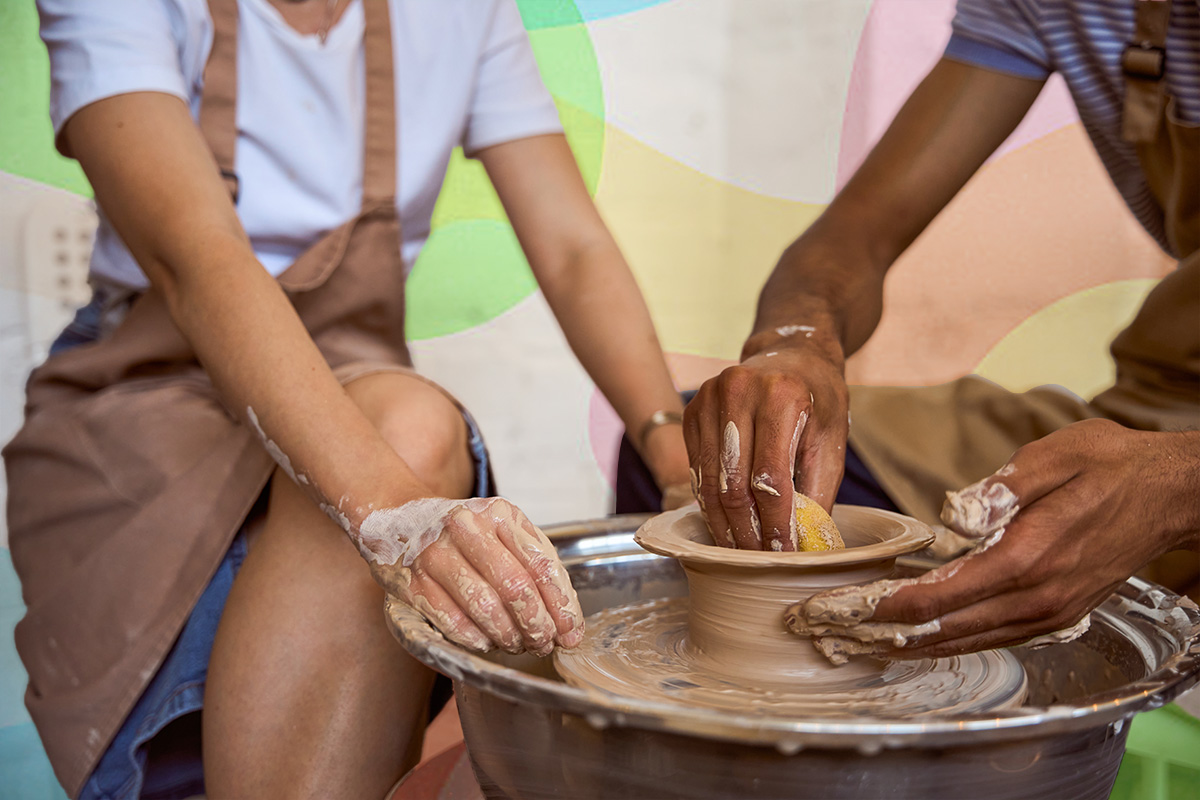
If you've never thrown clay, you're missing out on one of the most satisfying sensory experiences available to human beings. It demands your full attention. You can't be spiraling about your next appointment when you're trying to center clay on a wheel. Most cities have affordable, beginner-friendly community pottery classes. Go with a friend. Make something ugly. Laugh about it. Feel better.
Embroidery or cross stitch
This one has had a full glow-up and deserves its flowers. Modern embroidery is bold, expressive, and sometimes a little unhinged in the best way. People are stitching everything from affirmations to album covers to things that absolutely cannot be repeated here. Find a pattern that speaks to you and get into it. Your hands will thank you. So will your nervous system.
Woodworking
Woodworking takes more commitment than the other hobbies on this list, but the payoff is real. You start with a piece of wood, and you end with something that didn't exist before you started. That feeling doesn't get old. Check social media for beginner tutorials, or consider taking classes at your local community center if you want hands-on help getting started. If you're a fan of Parks and Rec, Nick Offerman (Ron Swanson himself) has a whole book dedicated to the craft of woodworking that's worth checking out.
BYO Hobby
This is by no means a complete list. Collaging, drawing, painting, photography, 3D printing; the list goes on. The most important thing is to pay attention to what lights you up and helps you unwind from those everyday nagging worries.
This is self-care. Full stop.
Living with HIV means you already know how to show up for your health in big ways: taking your meds, making your appointments, staying in care. But mental health is part of that care too. And it doesn't always look like therapy or meditation. Sometimes it looks like dirt under your fingernails, a half-finished embroidery hoop on your coffee table, or a Lego set spread across your living room floor at midnight.
The goal isn't perfection. It's giving yourself something to do that has nothing to do with your status, your labs, or anyone else's opinion of you; just you, your hands, and a little proof that you can create something good.